• Published: Jan 31st, 2010
  • Category: Urwerk
  • Comments: None

SIHH 2010 – URWERK 203

Tags: , ,

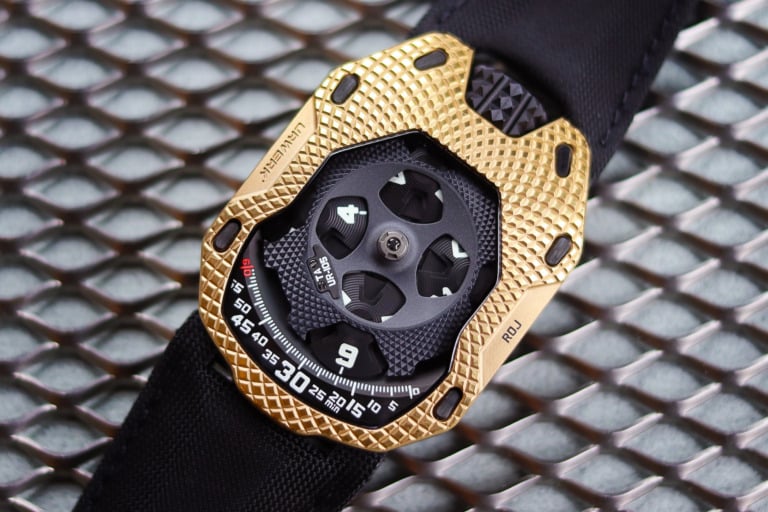
URWERK released a new version in the 200 collection, the URWERK 203. It’s main difference with the rest of the collection, is that it reveals its micro-mechanics for all to see.

The URWERK 203’s case is made of black platinum, a great addition next to the rose & white gold and the AlTiN coated URWERK 202. AITiN was also used for the URWERK 103 Tarantula. However the main difference is it shows the robotic functions of URWERK’s mechanisms to show time.

Robotics? Yes robotics, because URWERK doesn’t use an hour and minute hand like the majority of mechanical watches. The satellite complication is the nerve centre of the UR-203, crafted from ARCAP P40, a stable non-ferrous and non-magnetic alloy. The intricate structure is skelletonized to reveal the internal clockwork. Within the UR-203 the cams, the rubies and the transporters that ensure the alignment of the telescopic hands indicating the minutes, are all revealed.

The telescopic minute hands precisely adjust their length to follow the three vectors marking the minutes: 0 -14; 15 – 44; 45 – 60. Extended, they enable the UR-203 to display the time across a large easy-to-read, dial. Retracted, they allow for a smaller, comfortably sized case providing the wearer with the best of both worlds.

To make a stripped down model distilled to its pure essence, like Martin Frei (URWERK co-founder and designer) wanted, they had to start again at the beginning. Felix Baumgartner, URWERK co-founder and master watchmaker, says they sat down at the drawing board and completely reconsidered the satellite module. “The horological challenge with this complication was to develop a complex mechanism with the minimum of components to ensure its reliability and longevity.

Now the carousel, hour satellites, telescopic minute hands and dial weigh 65% less than the proceeding model (UR-202). The satellite complication now tips the scales at a feather-light 3.57 grams.

URWERK 203

Click on the photo to enlarge

The dial shows an «Oil Change» indicator and a 150 year «Horological Odometer». The «Oil Change» indicator informs the wearer when a service is due; an operation recommended every three years of movement operation. Similar to the odometer of a car, the UR-203’s «Horological Odometer» keeps track of the total number of years of operation of the movement.

The UR-203 is also equipped with URWERK’s double turbine system, the same automatic winding system that is used in the watches of the 200 collection. The turbines are mounted on rubies and are controlled by a three-position lever offering the choice of « FREE », « SPORT » or « STOP ». The position determines the force available from the automatic rotor to wind the mainspring. FREE, where the turbines spin freely; SPORT, where the air pressure generated by the turbines reduces the winding rate by approximately 35%; and STOP, where the turbines and rotor are fully blocked. The speed of the turbines can reach a maximum 16,500 RPM.

Check out the URWERK website for more details and other models.

Baselworld 2010 – Glashütte Original

Tags: ,

Glashütte Original already shows us 2 of their new models for Baselworld. The new Senator Sixties PanorameDate and the PanoMaticLunar XL. I think we already have a winner!

The Glashütte Original Senator Sixties, which was released during Baselworld 2007, received massive applause from watch lover all around the world. In 2008 they released a chronograph version, that was also praised. Last year Glashütte Original released yet another version of the Senator Sixties, the Sixties Square Chronograph.

This year finally a version with the typical Glashütte Original Panorama Date, the Senator Sixties Panorama Date. The normal Senator Sixties is in my opinion a beautiful and stylish dress watch, however with addition of the Panorama Date it has a function that is great for daily wear at the office as well.

I think Glashütte Original did a good job positioning the Panorama Date not at the 3 position or between 4 and 5, but centered above the 6 position. This way the dial looks very balanced. Another good detail, GO paid attention to is the black date disks and the white numbers. Well done!

This new model is available with a black or silver dial. The black dial has silver Arabic numerals, white gold baton hour, minute and seconds hands and hour markers. The silver dial has black Arabic numerals, rose gold hands and hour markers and the Panorama Date has black numerals on a white background.

The 42 mm large stainless steel case is 3 mm bigger than the time-only version. Other features like the domed sapphire crystal in front (with anti-reflective coating on both sides) and the sapphire crystal in the back (single sided anti-reflective coating) that is shaped around the movement are still the same.

Until now the PanoMaticLunar XL was only available in rose and white gold. This year Glashütte Original releases a version in stainless steel and with a new dial color…. grey. After another PanoMatic XL model that totally rocked my boat, yet another model in this collection that i just adore. . I think it’s absolutely beautiful and i’m really looking forward to seeing it ‘in the metal’ during Baselworld.

All other specifications remain the same and can be found on the Glashütte Original website.

  • Published: Dec 29th, 2009
  • Category: Sarpaneva
  • Comments: 3

Sarpaneva wins two design awards… again!

Tags:

Sarpaneva watches receives two ‘good design’ awards for the Sarpaneva Korona K3 Black Moon. The awards of the Chicago Athenaeum, Museum of Architecture and Design, are for the limited edition of Sarpaneva Korona K3 Black Moon wristwatch and for its product identity.

In August of this year, I already wrote that Sarpaneva was granted the Red Dot Design Award, also for the Korona K3 Black Moon.

Sarpaneva Korona K3 Black Moon

Sarpaneva Korona K3 Black Moon

The Good Design Awards where founded in Chicago in 1950 by architects Eero Saarinen, Charles and Ray Eames, and Edgar Kaufmann Jr. It’s one of the world’s oldest and most prestigious competitions for new product design and graphics.

Sarpaneva also developed a Black Moon iPhone app. The Black Moon is the first mechanical wristwatch to indicate the invisible and ever mysterious new moon, the dark opposite of the full moon. According to an ancient legend the seductive temptress, Lillith, preys on unwitting men during the new moon. So if you can’t buy one of the 20 Korona K3 Black Moon watches, the iPhone app is here to warm you in time for the dangers of the new moon.

Sarpaneva Korona K3 Black Moon iPhone app

Download the Black Moon iPhone app from the iTunes store or via Sarpaneva’s website.

Jaeger LeCoultre wins Chronometrie 2009

Tags:

Jaeger-LeCoultre wins the Chronometrie 2009 International timing competition for mechanical wristwatches with the Master Tourbillon. In fact Jaeger-LeCoultre won not only the first price, also picked up second place for the Reverso Gyro Tourbillon 2.

The two Jaeger-LeCoultre watches were adjusted by a team led by the firm’s technical director, Mr Jean-Claude Meylan. The photo below shows the movement of the first winner of the Chronometrie competition in 37 years, Jaeger LeCoultre Calibre 978 of the Master Tourbillon.

Jaeger LeCoultre Calibre 978

Jaeger LeCoultre Calibre 978

This was the first time since 1972 that this official timing competion was held. The Chronometrie International timing competition for mechanical wristwatches was last held in 1972 at the Neuchâtel observatory. This years’ competition was held to mark the 50th anniversary of the watch museum in Le Locle.

Jaeger LeCoultre Master Tourbillon

Jaeger LeCoultre Master Tourbillon

Entering a competition like this places a heavy demand upon the skill of the master “regleur” and upon the quality of the watch and its movement. The full test lasts a period of 45 days. During this time three 15-day tests are performed. The Chronometrie 2009 competition took things a step farther than the classic observatory trials. In the final phase of the testing fully assembled watches, instead of un-cased movements, were given a final test of precision. This last test comprises extensive shock and magnetism trials. By doing so they attempt to replicate daily situations a watch might encounter when worn.

Usually a watch runs a few second fast/slow per day. If a watch has been tested by the C.O.S.C. and the results where positive, it gets a chronometer certification. This means the movement is individually tested for several consecutive days, in 5 positions and at 3 temperatures. The average deviation may be -4 seconds or + 6 seconds per day.

Now imagine… during the 45 days of testing of the Chronometrie 2009 competition the Jaeger LeCoultre Master Tourbillon gained on average 0.13 seconds per day…

Jaeger LeCoultre Master Tourbillon

Jaeger LeCoultre Master Tourbillon

The Jaeger LeCoultre Master Tourbillon has a list price of 35,ooo euro (or just below 50,000 USD) for the steel version. Lately i’ve seen these watches for very nice prices. New they can be found for around 30% discount, used watches for almost 50% off of the list price. If you are interested in this watch, now is the time to buy. I can only imagine prices to go up after winning this prestigious contest.

The world’s most precise watch can be found for less than € 20,000 euro!! But for how long…

A good and trustworthy resource for used watches is Chrono24.com.

© 2009 Monochrome – Fine watches. All Rights Reserved.

This blog is powered by Wordpress.